Warehousing in Logistics in 2026: Types, Functions, and Business Benefits
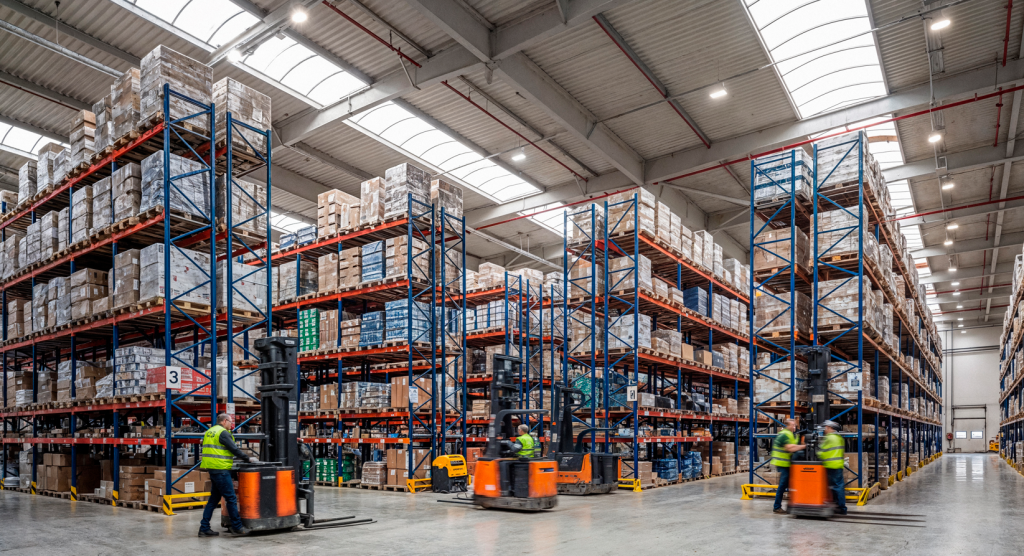
Warehousing in logistics has become a strategic advantage rather than just a storage activity. With increasingly complicated supply chains and higher demands of customers, companies are using intelligent warehousing logistics to manage inventory, decrease their lead times and enable scalable growth.
As business operators assess their logistics infrastructure, it is important that they grasp how warehousing is integrated within logistics and supply chain management.
Snapshot Summary
Warehousing in logistics refers to the systematic storage, handling and movement of goods within the supply chain to ensure products are available at the right time, place and quantity.
What Is Warehousing in Logistics?
Warehousing in logistics is the process of storing goods before they are distributed to retailers or distributors. It includes inventory handling, order preparation and coordination with transportation networks.
Unlike traditional storage, modern warehousing logistics focuses on speed, visibility and efficiency rather than long-term holding.
Role of Warehousing in Logistics
The role of warehousing in logistics has expanded significantly in recent years. Warehouses now act as control centers within supply chains.
Key Roles
- Balancing supply and demand
- Reducing transportation costs
- Supporting e-commerce and retail fulfillment
- Enabling faster last-mile delivery
- Improving inventory visibility
Warehousing in Logistics and Supply Chain Management
Warehousing in logistics and supply chain management connects manufacturing, transportation, and customer delivery into a single operational flow.
How Warehousing Supports Supply Chains
| Supply Chain Area | Warehouse Contribution |
| Procurement | Buffer stock management |
| Production | Raw material availability |
| Distribution | Faster order processing |
| Retail & Ecommerce | On-time fulfillment |
| Returns | Reverse logistics handling |
Types of Warehousing in Logistics
Understanding the types of warehousing in logistics helps businesses choose the right model based on scale, product type and distribution needs.
1. Private Warehouses
- Owned and operated by businesses
- Suitable for high-volume operations
- Greater control, higher investment
2. Public Warehouses
- Shared storage facilities
- Pay-as-you-use pricing
- Flexible for small and mid-sized businesses
3. Contract Warehouses
- Long-term agreements with logistics providers
- Customized services
- Balanced cost and control
4. Distribution Centers
- Designed for fast order movement
- Focus on picking, packing, and shipping
- Core to ecommerce logistics
5. Specialized Warehouses
- Cold storage
- Hazardous goods storage
- Compliance-focused facilities
Functions of Warehousing in Logistics
The functions of warehousing in logistics go far beyond storage.
Core Functions
- Receiving and inspection
- Inventory management
- Order picking and packing
- Labeling and value-added services
- Dispatch and shipping coordination
Strategic Functions
- Risk management
- Demand forecasting support
- Cost optimization
- Service-level improvement
Modern warehousing logistics integrates technology to automate these functions efficiently.
Benefits of Warehousing in Logistics for Businesses
Businesses in 2026 rely on warehousing in logistics to stay competitive.
Key Benefits
- Faster order fulfillment
- Reduced transportation costs
- Better inventory accuracy
- Improved customer satisfaction
- Scalability during demand peaks
Centralized vs Distributed Warehousing
A centralized warehouse model stores inventory in one main location, while distributed warehousing spreads stock across multiple regions.
Comparison
| Factor | Centralized | Distributed |
| Inventory control | High | Medium |
| Delivery speed | Slower for distant regions | Faster locally |
| Cost structure | Lower facility cost | Higher operational cost |
Choosing the right approach is critical to effective warehousing logistics planning.
Technology in Warehousing Logistics
Technology defines modern warehousing in logistics.
Key Technologies
- Warehouse Management Systems (WMS)
- Automation and robotics
- Barcode and RFID tracking
- AI-driven demand forecasting
- Real-time inventory dashboards
How Businesses Choose the Right Warehousing Partner
When selecting a warehousing provider, business owners should evaluate:
Step-by-Step Checklist
- Storage and handling capabilities
- Industry compliance requirements
- Technology integration
- Scalability options
- Geographic coverage
Fulfillment Plus is a trusted warehousing partner designed to support accuracy and reliability at scale. We achieve up to 99% order accuracy while keeping return rates minimal through structured workflows and rigorous quality control processes.
FAQs: Warehousing in Logistics
It ensures inventory availability, reduces delivery delays and supports efficient order fulfillment.
By optimizing storage, minimizing transport frequency and improving inventory accuracy.
Ecommerce, retail, food, pharmaceuticals and manufacturing.
Yes, warehousing in logistics and supply chain management are closely interconnected.
Warehousing includes inventory movement and order processing, while storage focuses only on holding goods.
Automation, data visibility and faster fulfillment models define modern warehousing logistics.
WMS platforms, automation, and real-time inventory tracking.
Yes, public and contract warehouses offer flexible options.
They enable fast picking, packing, shipping, and returns handling.
Why Warehousing in Logistics Matters in 2026
In 2026, warehousing in logistics is a growth enabler, not just a cost center. Businesses that invest in efficient warehousing logistics gain better inventory control, faster fulfillment and stronger customer trust.