43 Years in Fulfillment: What Four Decades Teaches You About Reliable Shipping
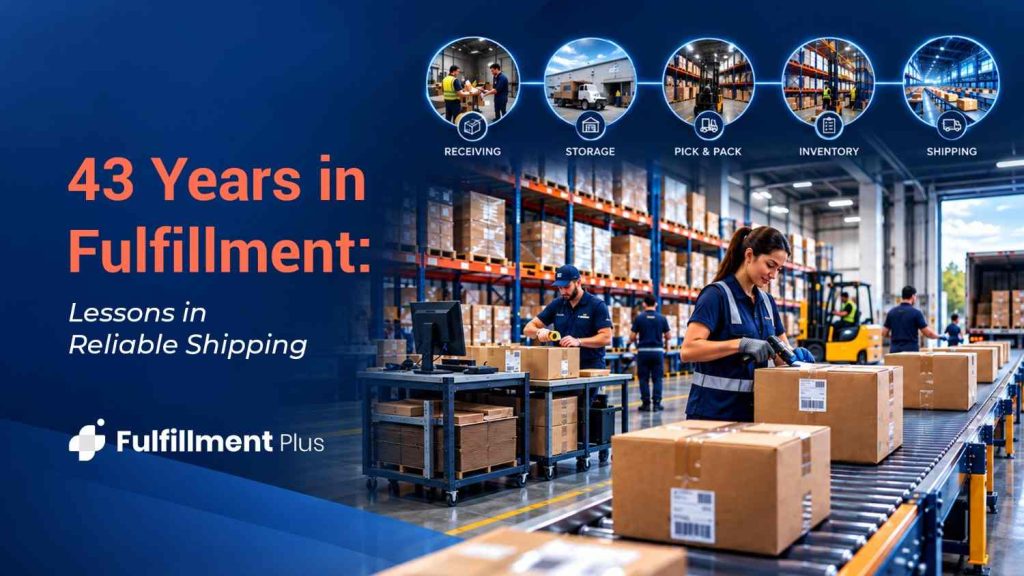
Most fulfillment companies talk about speed. Fewer can talk about survival. Fulfillment Plus has spent 43 years in the warehousing and shipping business, which means the company has operated through recessions, retail collapses, fuel price shocks, and at least three complete rewrites of how ecommerce works. That kind of run does not happen by accident. It happens because the business figured out, early and repeatedly, what it actually takes to become a reliable 3PL fulfillment partner instead of just another warehouse with a website.
This post breaks down what four decades in the industry actually teaches a company about reliable shipping, and why that history still matters when a brand is choosing who touches their inventory next.
Why Longevity Still Matters in a Crowded 3PL Market
Venture-backed 3PLs have flooded the market over the last several years, many of them optimized for rapid onboarding and flashy dashboards. Some of that innovation is genuinely useful. But speed to sign up is not the same thing as staying power, and plenty of newer providers have folded, restructured, or quietly changed ownership within a few years of launching.
A company that has run warehouses for over forty years has already survived the mistakes that sink younger competitors. It has renegotiated carrier contracts through fuel crises, adjusted staffing models through minimum wage shifts, and rebuilt processes around three or four completely different generations of ecommerce platforms. Brands evaluating a reliable 3PL fulfillment partner should weigh that operational history as heavily as pricing sheets, because pricing is easy to match and survival is not.
Lesson One: Reliable Shipping Starts With Operational Discipline, Not Hype
The first thing four decades teaches you is that shipping reliability is boring, repetitive discipline dressed up as a service. It is barcode scans before every item leaves the shelf. It is a returns process that gets followed the same way on a slow Tuesday and a chaotic peak week in December. It is knowing exactly where a pallet sits without needing to walk the floor to check.
A 3PL that has done this for decades has usually already broken the process in every way it can break, and fixed it. That is what separates a fulfillment company with decades of experience from one still discovering its failure points on a live client’s orders.
Lesson Two: A Reliable 3PL Fulfillment Partner Builds Systems That Outlast Trends
Technology changes fast in logistics. Warehouse management software, RFID tracking, and automated slotting have all reshaped how fulfillment centers operate over the last twenty years alone. A company built for the long haul does not chase every new platform. It adopts what actually improves accuracy and stability, then integrates it into a system that keeps working when the next trend arrives.
That is a meaningful difference from providers built entirely around one moment in ecommerce history. A reliable 3PL fulfillment partner treats new technology as a tool for consistency, not a substitute for it.
Lesson Three: Real Experience Shows Up in How Problems Get Solved
Every fulfillment operation eventually deals with a supplier delay, a mislabeled shipment, or a carrier network disruption. What separates a seasoned operator from a newer one is not whether problems happen. It is how fast they get caught, who takes ownership, and whether the client finds out from the 3PL or from an angry customer email.
Decades of handling recalls, seasonal surges, and carrier shortages tends to build institutional memory that shows up exactly when it is needed most. That memory is hard to fake and even harder to build quickly, which is part of why brands searching for a reliable 3PL fulfillment partner tend to ask pointed questions about past disruptions during vetting calls.
Lesson Four: Scale Without Losing the Personal Touch
One of the harder lessons a long-running 3PL learns is that growth and personal attention are not automatically at odds. Bigger warehouse networks and higher order volumes can easily turn into slower response times and a client feeling like just another account number.
Companies that last decades tend to figure out how to keep account management personal even as their footprint expands into new markets and new fulfillment centers. That balance, hands-on service paired with real infrastructure, is often the actual differentiator brands notice once they switch from a newer 3PL to a more established one.
What Four Decades of Fulfillment Plus Experience Looks Like Today
At Fulfillment Plus, that history is not just a talking point. It shows up in pick and pack fulfillment services built around barcode verification at every step, in a centralized warehouse model designed to reduce handoffs and errors, and in inventory management systems that give brands real-time visibility instead of end-of-week guesswork.
It also shows up in how the company approaches value-added warehousing services like kitting, labeling, and quality checks, treating them as core parts of fulfillment rather than optional extras bolted on later. Forty-three years of adjustments have gone into building a full range of 3PL services that can flex for a growing DTC brand one month and a large enterprise account the next.
How to Recognize a Reliable 3PL Fulfillment Partner When Evaluating Providers
Brands vetting a new warehousing partner rarely get a clean look at operational history from a sales call alone. A few practical signs tend to hold up:
- The provider can describe specific past disruptions and exactly how they responded, not just general reassurances.
- Account management stays consistent, rather than routing every question through a rotating support queue.
- Technology investments are explained in terms of accuracy and stability, not just speed claims.
- References or case studies span multiple years, not just a recent funding round.
Understanding how warehousing fits into modern logistics more broadly also helps brands ask sharper questions during evaluation, rather than relying on a provider’s own pitch deck to define what reliability means.
Frequently Asked Questions
What makes a 3PL provider reliable? A reliable 3PL provider combines consistent order accuracy, transparent communication during disruptions, and infrastructure that has been tested across multiple economic cycles and ecommerce shifts, not just built for a single growth phase.
Why does a fulfillment company’s operational history matter? Operational history shows how a provider has actually handled past disruptions, seasonal surges, and technology transitions. It is a stronger signal of future performance than pricing or a sales pitch alone.
What are the signs of a trustworthy 3PL? Trustworthy 3PLs tend to show consistent account management, specific answers about past problems and fixes, and technology decisions tied to accuracy rather than marketing.
How long has Fulfillment Plus been in business? Fulfillment Plus has operated as a warehousing and fulfillment company for 43 years, giving it direct experience across multiple generations of ecommerce platforms and shipping conditions.
Choosing a reliable 3PL fulfillment partner is rarely about finding the flashiest dashboard. It is about finding a team that has already been tested by the kind of disruptions every growing brand eventually faces, and came out the other side with better processes instead of a worse reputation. After 43 years, that is exactly what Fulfillment Plus brings to the table for brands ready for their next phase of growth.
Know more about our services – YouTube, LinkedIn, Instagram
Sources referenced: 3PL Longevity: How Providers Thrive Through Decades or Centuries, Inbound Logistics